The 2012 Centre for Business Innovation (CBI) survey shows that a majority of Canadian firms will change their business models in the next five years. For these firms, business model innovation is key to achieving higher competitive differentiation.
In the broadest sense, a company’s business model is the entire system of activities by which the company interacts with customers and the other players in the market. It involves the intertwined relationship of customer value proposition, key resources and processes, and profit formulas. Most often, the leading company in any market segment is the one that managed to be a significant business model innovator.
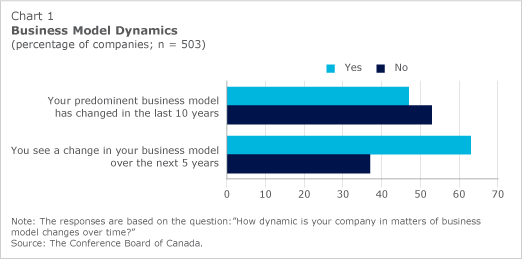
The importance of business model innovation stems from the fact that it often provides a more sustainable competitive advantage, and is more difficult to replicate than product or service innovations. Business model innovation value is defined by its:
- novelty
- lock-in capability
- reinforcing complementarities
- efficiencies
Business model innovation implies changes to many corporate activities and relationships. Rewards (and risks) are greater than pursuing innovation in individual domains of competitiveness.
CBI has used the MIT Sloan School framework1 to characterize the distribution of business models among Canadian firms. Many Canadian firms pursue hybrid models: about 70 per cent follow two business models and 43 per cent identify a tertiary one as well.
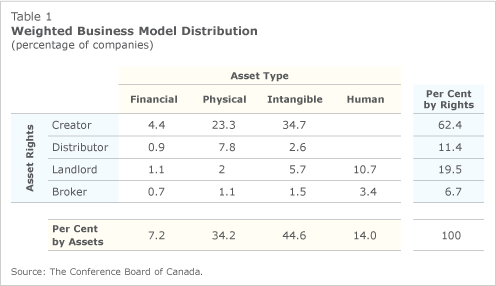
Industry executives, who see their companies as being intangible asset creators, are the largest group, followed by those who are physical creators (manufacturers).
A look at relationships between business models and average firm performance reveals that, in Canada, the physical distributors and the financial institutions have a more rewarding performance, on average, while intangible creators perform less well than the entire set of firms surveyed.
Many successful companies use multiple models to reinforce their interactions with customers and the market. Examples abound. Apple—as the physical creator of iProducts and the broker of music, video, and software application content through its iTunes service—is one example. The fact that these two business models reinforce each other gives Apple a tremendous market advantage with customers and suppliers. Likewise, Amazon, which is largely a distributor, has found value in also being a physical creator of the Kindle (and possibly its own brand of smartphone in the future) as products that will give its customers better access to distributed content.
The variance with the findings of the MIT Sloan team—which determines that intangible creators are most appreciated by the market in our times—may be because the U.S. analysis was done solely on public U.S. firms that operate mainly in the large American market. In the CBI analysis, only 10 per cent of companies are public. Most are focused solely on the much smaller Canadian market—within which the intangible creation model has a lower chance to show high value.
The leading company in most market segments is the one that manages to be a significant business model innovator, such as FedEx or Xerox at the beginning; Dell or Nike, Home Depot, Carrefour or ING Direct; or Walmart or Apple today. In most cases, it was not a technology or a particular competitive element that made the difference, but the integration of them all into a coherently dynamic system—a business model innovating company. Often, the crucial characteristic of the leading company is a strong culture of innovation that starts from the top and permeates all aspects of the organization and its interactions with the market.
Company leaders should ask these fundamental questions concerning their business model innovation strategies to ensure that they understand customer needs and market dynamics:
- What are our business models today and how have they changed over the past years?
- How does our company compare with its competitors—both traditional and non-traditional?
- Which business models should our company pursue to enhance its value to customers?
- How can our company be restructured to emphasize business models that bring more value to customers and are more appreciated by the market today?
- Which capabilities—skills, competencies, infrastructure platforms, and partnerships—are required to successfully change?
- Which innovations could help ensure the validity of our business models for “tomorrow”?
Business model innovation can affect entire industry sectors, notably when innovation leads to new value systems and disruptive market evolution—as happened with the transition to steam power, to the Internet, and to clean tech. Traditional fascination with technology innovation, and public focus on supporting the achievement of technology breakthroughs, have obscured the fact that who makes the discoveries is less important than who commercializes them faster and better, or whose business models lead to higher value creation for the customers in the marketplace.