Innovation is much more than just research and development. Signal49 defines innovation as the process through which economic and social value is extracted from knowledge by generating, developing, and implementing ideas to produce new or improved strategies, capabilities, products, services, and processes. This broad umbrella covers a wide variety of business models, innovation strategies, and corporate efforts to produce higher value products, services, operational processes, and business platforms.
Most firms think of innovation as a means to an end and not an end in itself. For these firms, it is a way to maintain or improve their competitive position in the market and, ultimately, to generate more sales and/or larger profits. Disruptive radical innovations may lead to the creation of new economic entities, industries, and even entire markets. Still, most firms pursue incremental innovations to achieve new or improved products and services, changes in customer experiences or satisfaction, brand and marketing outcomes, territorial expansion or change, and environmental and social outcomes.
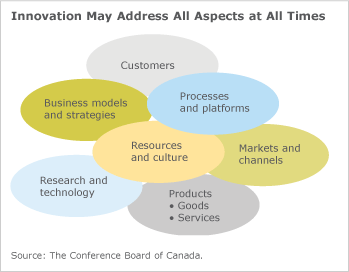
Business model innovations—which deliver new and more competitive ways for a company to interact with the market, customers, partners, and even competitors—have high strategic values as they may lead to sustainable market leadership for the successful company. A firm may innovate using a variety of resources, including its:
- people—managers and employees;
- infrastructure (platforms) of the company—the buildings, machinery, tools, software, and the product/service technology platforms, etc.;
- partnerships—all those external firms and institutions that the company collaborates with to conduct its business effectively. These include technology partners, marketing partners, suppliers, distributors, lobbyists, etc.
The corporate culture and its organizational structure are key targets of innovation as well. Recent studies have shown that “culture is key” for success1 and that “spending more on research and development won’t drive results. The most crucial factors are strategic alignment and a culture that supports innovation.”
Corporate processes—i.e., the ways in which the company carries out its activities—have a major impact on the firm’s competitiveness and represent an important target for innovation. Each process—from administration to financial management, from research and development to customer service, from supply to distribution, from legal to human resource management, and from production to quality assurance, etc.—may require innovation at one time or another. And so does the innovation management process itself.
The 2012 CBI Survey on Innovation Management and Metrics shows that Canadian firms innovate in all the ways discussed above. Most frequent was product innovation (18.4 per cent of companies), closely followed by customer-experience oriented innovation (17.6 per cent). Next in importance were service innovations and technology platform innovations, followed by process innovations. At much lower levels were business model innovations, market/territory innovations, and customer-type innovations, which aim at attracting new classes of customers for the company.
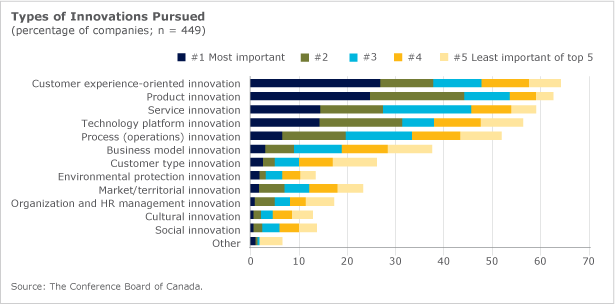
Young companies, less than five years old, are more interested in technology platform, business model, and environmental protection innovations. Companies 6–10 years of age were more interested in market/territory innovations—something that usually happens in the growth phase of a company. Mature (11–30 years old) companies emphasized product and customer-experience innovations, while older companies (over 30 years old) showed more predilection for service and process innovations as well as human resource management and customer-type innovations.
Size also affects innovation focus. Large companies emphasize process, organization, cultural, and service innovations ahead of the average. Mid-size companies emphasize technology platform, customer-type, process, and business model innovations. Small companies are more interested in product and technology platform innovations. Very small companies show a preference for customer-experience, business model, service, and social innovations.
These findings raise questions about the emphasis placed by governments on supporting technology-oriented innovations in small and medium-size enterprises (SME) at the expense of the other types of innovations that many SMEs find necessary to undertake for competitive reasons.