Signal49’s Centre for Business Innovation (CBI) recently conducted a major survey of businesses about their innovation practices and performance. The survey, which generated over 630 responses from companies, explored which innovation strategies Canadian firms adopt, how they manage their innovation activities, and what Canadian cultural and ecosystem factors impact innovation performance.
Alarm bells have been sounding over Canada’s underwhelming innovation performance for more than a decade, harming our competitiveness in world markets. Most business executives claim knowledge of innovation as a primary engine of growth. However, many are unclear about how to manage innovation effectively in their own firms. According to Signal49’s 2012 CEO Challenges Survey, CEOs rank innovation as only their 7th priority—down one peg from the previous year when it was ranked 6th. Consequently, it should not be a surprise that Canada ranked 22nd overall on indicators of innovation in the World Economic Forum’s Global Competitiveness Report 2012–2013.
Innovation-related policy in Canada has focused on improving R&D, academic research, and technology development as underpinnings of innovation. However, Canada’s problem is more a commercialization gap than an innovation gap. Our commercialization gap is largely due to five factors:
- lack of commercialization expertise and business management acumen;
- a weak culture of collaboration that exacerbates the difficulties of operating in a global marketplace dominated by strong competitors from abroad;
- insufficient capitalization and funding for commercialization that inhibits companies from attaining their potential and turns them into easy prey for foreign companies;
- lack of will, competitive drive, and strengths necessary to succeed in fierce competition in world markets;
- inadequate management of innovation activities to achieve tangible performance results.
Despite these weaknesses, relatively little policy attention has been paid to critical areas of market competitiveness, such as business models; financial capabilities; commercial processes; and entrepreneurial, cultural, and organizational aspects of leadership—topics examined in our online survey.
Respondents were senior executives: 55 per cent were C-suite executives while a further 23 per cent were senior managers directly in charge of innovation in their organizations. The vast majority of companies responding are Canadian, almost half of whom are Ontario-based. More than two-thirds are at least 10 years old. Three-quarters have revenues under $50 million, with 10 per cent having revenues over $1 billion.
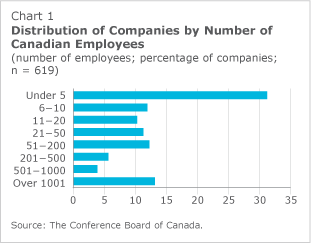
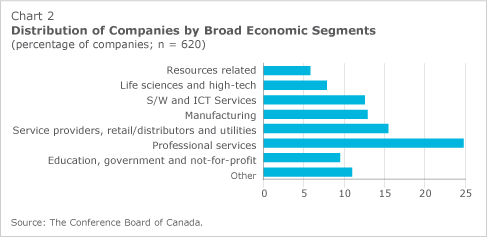
The economic sector distribution was representative of the diverse nature of Canadian industry.
One of the most striking findings from the survey is that most Canadian companies consider their home province as their primary market target. Interest in the rest of Canada or the U.S. is weaker. Very few companies report a strong interest in markets outside North America and Europe. Their lack of interest in global markets tends to diminish their competitive drives and innovation for leadership growth.